
Bamboo Decking: Hidden Fasteners vs. Face Screwing Without Splitting
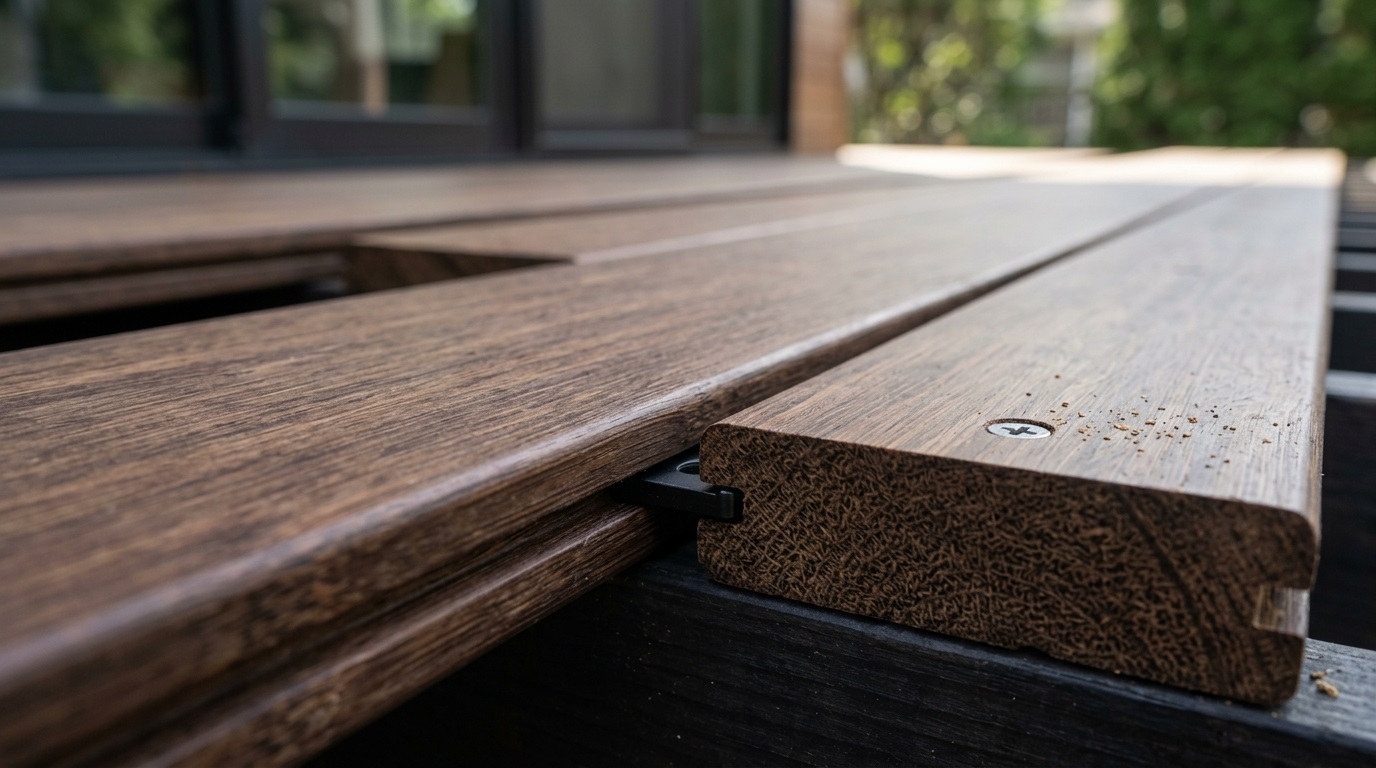
Choosing between hidden fasteners and face screwing for bamboo decking comes down to three practical factors: board profile, structural exposure, and how much surface maintenance you want down the road. For most residential patios built with grooved thermo-treated planks, stainless steel hidden clips deliver a clean, barefoot-friendly deck with built-in spacing. For stair treads, perimeter picture frames, square-edge boards, or commercial boardwalks under heavy foot traffic, pre-drilled stainless steel face screws offer stronger direct holding power. Whichever route you take, preventing splits starts with treating outdoor bamboo like an ultra-dense tropical hardwood rather than softwood lumber or standard plastic composite.
Installers who approach strand-woven bamboo with pine-decking habits usually run into trouble within the first ten boards. Screws snap halfway down, fibers crack near butt joints, and drill bits overheat before the first row is finished. Understanding how the material behaves under hardware makes the job far smoother and keeps every joint tight through years of rain, sun, and temperature swings.
Why Strand-Woven Bamboo Decking Splits Under Standard Fasteners
Outdoor bamboo decking is not hollow grass glued together. Manufacturers shred mature bamboo culms into fine fibers, thermally treat them to remove sugars and stabilize cell walls, and compress those fibers with outdoor-grade resin under extreme pressure. The finished thermo-treated plank reaches a density between 1,050 and 1,200 kilograms per cubic meter, commonly hovering around 1,150 kilograms per cubic meter. On the Brinell hardness scale, that pushes the surface above 9.5 kilograms per square millimeter, making it more than twice as hard as traditional oak.
Softwoods like pressure-treated pine or western red cedar forgive sloppy fastening because their cellular structure crushes inward around a screw shank. Dense strand-woven bamboo has almost no give. When you drive a self-tapping deck screw straight into an un-drilled bamboo board, the threaded shaft acts like a steel wedge. Outward pressure builds rapidly inside the tight fiber matrix until one of two things gives way: the bamboo fractures along the grain, or the torque shears the head right off a stainless steel screw.
Seasonal moisture changes add another layer of stress. Thermo-treated bamboo is markedly more stable than untreated hardwoods—standardized 24-hour water immersion tests typically show around 0.1 percent movement along the length and roughly 0.9 percent across the width—yet boards still breathe with outdoor humidity. Fasteners that clamp a plank too rigidly at the wrong distance from an edge or end create localized pinch points that open into hairline splits after a single dry summer.
How Hidden Fasteners Work on Bamboo Decking
Hidden fastener systems lock onto grooved-edge bamboo planks using clips that seat inside side channels milled along both long edges of each board. You slide a clip into the groove of an installed plank, drive a screw down through the clip into the joist below, and slide the next grooved board snugly against the opposite wing of the clip. Once the next board is in place, the screw sits out of sight inside the shadow gap between rows.
Clean Surface and Even Gaps
The main appeal of hidden clips is an unbroken deck surface. Without hundreds of screw heads breaking the top face, bare feet stay safe from raised burrs or popped hardware, and rainwater has far fewer entry points into the upper fibers of the board. Clips also act as built-in spacers. Depending on the hardware system, most bamboo decking clips establish a consistent gap between 3/16 inch and 1/4 inch across the entire deck. That uniform channel lets air circulate underneath the planks so moisture dries evenly from both top and bottom faces, reducing cupping over time.
Stainless Clips Over Plastic
Material choice inside the clip itself matters just as much as the installation technique. Standard nylon or unreinforced plastic clips designed for lightweight wood-plastic composite boards often flex or fatigue under the weight and seasonal push of high-density bamboo. Experienced builders stick with black-coated stainless steel clips—typically 305-grade stainless for inland builds and 316 marine-grade stainless near pools or coastal salt air—paired with matching stainless screws around 4.5 by 30 millimeters. Steel clips grip the milled groove firmly while still allowing slight lateral slide as planks expand and contract across their width.
Where Hidden Clips Struggle
Hidden fasteners do have real limits on the jobsite. First, clips are almost always profile-specific; a clip engineered for one brand’s groove thickness and offset may rattle loosely or sit too high in another manufacturer’s board. Mixing clips and decking brands mid-build is a common cause of uneven gaps and squeaky planks. Second, clipped installations demand flatter framing than face-screwed decks. While face screws can pull a slightly crowned board tight against a joist, hidden clips let planks follow the framing contour, so joists with crowns exceeding 1/8 inch over a ten-foot span should be planed or sistered before laying the first row. Finally, hidden systems still leave you needing starter clips or face screws on the first board, the closing perimeter row, diagonal miters, and stair treads.
Face Screwing Bamboo Decking Without Splitting
Face screwing remains the gold standard whenever raw mechanical grip takes priority over a completely fastener-free look. Because two screws pass straight through the thickness of the plank into every joist, the board cannot shift laterally or lift under high winds, heavy commercial foot traffic, or tight stair geometry. Done properly, face screwing produces crisp, aligned rows—or virtually invisible plugged holes—with zero edge blowouts.
Sizing Your Pilot Holes
Pre-drilling is mandatory on bamboo decking, without exception. To eliminate splitting and prevent snapped stainless shanks, drill a pilot hole sized to roughly 80 to 90 percent of the screw’s outer diameter. For a typical 5-millimeter stainless deck screw, a 3.2-millimeter to 3.5-millimeter drill bit gives the threads plenty of bite inside the underlying joist while removing enough bamboo mass to relieve outward wedging force inside the plank.
Standard high-speed steel twist bits dull fast in resin-dense bamboo, generating friction heat that scorches the hole walls. Switch to sharp cobalt or carbide-tipped bits, keep your drill speed moderate, and clear shavings frequently. Pairing your pilot bit with a dedicated countersink stop ensures every screw head seats flush with the board surface—never proud enough to catch a sandal, and never buried so deep that water pools inside a crater.
Safe Edge and End Spacing
Placement controls whether a board stays intact through winter freeze-thaw cycles and hot August afternoons. Keep every screw hole at least 3/4 inch—about 20 millimeters—inward from the long side edges of the plank. At butt joints where two board ends meet over a double joist, set your screws a minimum of 2 inches, or 50 millimeters, back from the cut end. Driving fasteners closer than 2 inches to an end almost guarantees fine end-checking as moisture exits the cut fibers.
Whenever you crosscut a bamboo plank on site, coat the freshly exposed end grain with a manufacturer-approved wax end sealer before fastening it down. Unsealed ends absorb and release rain far faster than the factory-finished faces, magnifying internal stress right around your end fasteners.
Picking the Right Screw
Skip coated carbon steel screws and cheap zinc-plated fasteners altogether. Even exterior ceramic coatings can scratch during installation in hard bamboo, inviting rust stains that bleed dark streaks into the surrounding grain. Use 305-grade stainless steel screws as a baseline for dry inland decks, and step up to 316 marine-grade stainless steel anywhere near oceans, brackish water, or saltwater swimming pools.
Length matters just as much as alloy. On standard 3/4-inch (20-millimeter) bamboo decking, use screws at least 2-1/4 inches long so you achieve deep withdrawal resistance inside the wood joist. On thicker 1-1/2-inch profiles, move up to at least 2-1/2-inch screws. Star-drive trim-head screws resist cam-out better than Phillips or square drives, and if you want the pull-down security of face screwing without exposed metal heads, countersink the fasteners slightly deeper and glue in color-matched bamboo plugs tapped flush with the surface.
Deciding Between Hidden Clips and Face Screws
Both fastening approaches can deliver a rock-solid bamboo deck for twenty years or more, provided the substructure supports them properly. Most residential bamboo installations rely on 16-inch on-center joist spacing, tightening to 12 inches on center for diagonal patterns, random layouts, or high-load spaces. Installing solid blocking between joists roughly every 72 inches prevents joists from twisting and pulling butt joints apart, and running self-adhesive butyl joist tape along the top of every wooden joist seals off water that tracks down screw shafts.
When weighing clips against face screws for your specific build, focus on how you plan to use and maintain the deck:
- Main patio visibility: Choose stainless hidden clips if the deck sits directly outside wide glass doors or around a pool where a smooth, uninterrupted surface matters most.
- Stairs, borders, and angles: Plan on face screwing stair treads, fascia trim, picture-frame borders, and sharp mitered corners where clips lack enough purchase.
- Framing tolerances and DIY speed: Face screwing moves faster for small crews once a rhythm of pre-drilling and driving is dialed in, and it handles minor joist irregularities better than clip channels.
- Hardware budget: Hidden clip kits paired with grooved planks generally cost more per square foot than stainless face screws, though they save time setting consistent side gaps with spacers and deck wrenches.
- Future repairs: Asymmetric hidden clips let you back out screws along one side and lift a single damaged plank cleanly from the middle of a deck without disturbing neighboring boards, whereas plugged face-screwed planks require drilling out plugs to remove a board.
In real-world construction, most seasoned deck builders combine both methods on the same project. They install the starter row, final perimeter row, and stair treads with pre-drilled stainless face screws and matching bamboo plugs for maximum anchor strength, then run stainless hidden clips across the entire main field so the walking surface stays smooth and consistent.
Common Questions About Fastening Bamboo Decking
Can You Skip Pre-Drilling?
No. Even screws marketed as self-drilling or equipped with serrated cutting tips struggle in compressed strand-woven bamboo. Skipping the pilot hole dramatically raises the risk of surface splits along the grain, blown-out board ends, and snapped stainless steel screw heads that are nearly impossible to extract cleanly.
Which Stainless Grade Works Best?
Grade 305 stainless steel handles standard inland residential climates reliably without corroding or staining the bamboo. If the deck sits within several miles of a coastline, overlooks a saltwater bay, or surrounds a chlorinated or saltwater pool, specify 316 marine-grade stainless steel for both hidden clips and face screws.
Can Damaged Boards Be Replaced?
Yes, though the effort depends on your hardware choice. Decks fastened with asymmetric hidden clips allow you to loosen the clips on one side, pivot the damaged board out, and drop a fresh board straight into place. Unplugged face-screwed boards are also straightforward to back out and swap, while glued bamboo plugs need to be carefully drilled out before unscrewing the plank. Taking twenty minutes during layout to match your fastener style to each zone of the deck prevents headaches during installation and keeps every bamboo board flat, quiet, and crack-free long after the tools are packed away.