Anyone who has stepped onto a sun-baked deck in bare feet knows the difference between warm and painful. On a July afternoon, one board can feel pleasantly sun-warmed while another, ten steps away, genuinely burns. If you are choosing between bamboo decking and composite decking, heat retention deserves a real place in the decision. It affects barefoot comfort, pet safety, how you use the space, and even how long the surface itself holds up under repeated thermal stress.
This article compares how bamboo and composite decking behave in direct summer sun, what actually drives those surface temperatures, and what you can do about it either way. The short answer up front: in most conditions, a light-colored strand-woven bamboo deck runs cooler at peak sun than a dark capped composite, and it also releases stored heat faster once the sun drops. But the material is only part of the story, and the details are worth understanding before you spend thousands of dollars.
Why Deck Surface Temperature Matters So Much
Air temperature is a poor guide to what your feet will feel. A deck in full sun can sit 40 to 70 degrees Fahrenheit above the surrounding air, because the boards are absorbing solar radiation all day, not just floating at ambient temperature. On a 90-degree afternoon, that puts many synthetic surfaces in the 130 to 160-degree range, which is hot enough to blister skin in seconds and far beyond what a dog‘s paw pads can tolerate.
There is a safety threshold worth keeping in mind. Human skin starts to take damage somewhere around 120 degrees of sustained contact, and the pain reflex kicks in well before that. Children, who spend the most time running barefoot across decks, and dogs, who have no shoes and fewer complaints, are the usual victims. Beyond the safety angle, a deck that is too hot to use between 11 a.m. and 5 p.m. is a deck that fails at its only job. A cooler surface quietly extends your usable hours every single day of the season.
It also affects the material itself. Repeated cycles of intense heating and nighttime cooling drive expansion and contraction. Boards that run hotter every day work harder thermally, which shows up over the years in fastener movement, gap changes, and surface wear.
What Actually Makes a Deck Hot
Before comparing materials, it helps to understand the mechanics. Four factors decide how hot any deck gets, and only some of them are about the material itself.
Sunlight absorption is the first and biggest. Dark colors absorb more of the solar spectrum and convert it to heat; light colors reflect more of it away. This is why a charcoal board and a sand-colored board of the exact same material can differ by 20 degrees or more at the surface. Color frequently matters more than what the board is made of.
Thermal mass is the second. Dense, heavy materials soak up large amounts of heat before their surface temperature climbs, but then they hold that heat and give it back slowly. Lighter or more hollow constructions heat up faster yet also cool down faster. This is where the afternoon peak and the evening recovery tell different stories, and where the two materials in this comparison genuinely part ways.
Surface conductivity is the third, and it is subtle. Two boards at the same temperature will not feel equally hot underfoot. A material that moves heat quickly into your skin reads as hotter than an insulating one at the same surface temperature. This is why metal handrails feel hotter than wooden ones in the sun even when measurements disagree. Natural fiber and plastic behave differently here, and it shapes real-world comfort.
Emissivity, meaning how efficiently a surface sheds heat back out as infrared radiation, is the fourth. Most decking materials, wood included, radiate heat reasonably well, which is why decks cool quickly once the sun leaves them. Plastics tend to radiate a little less efficiently, which contributes to that lingering warmth you notice on a composite deck after sunset.
Airflow underneath matters too. A ground-level deck trapped over a stagnant air pocket builds more heat than a raised deck with open ventilation below, simply because there is nowhere for the warm air to go. The gap spacing between boards also influences how much heat can escape through the surface layer.
How Bamboo Decking Behaves in the Sun
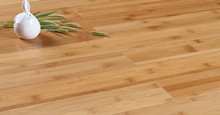
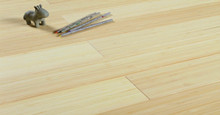
Exterior bamboo decking is almost always strand-woven bamboo, made by shredding the stalks into fiber bundles, saturating them with resin, and compressing them under heat into an extremely dense plank, usually finished with a UV-stabilized coating that includes aluminum oxide. The result is a natural-fiber product with the density of hardwood, typically harder than ipe, and with very little plastic in it.
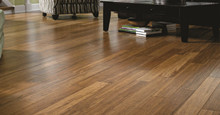
In practice, bamboo behaves much like dense tropical hardwood. In the natural and carbonized tones that dominate the market, a bamboo deck in direct summer sun commonly runs somewhere in the 110 to 130-degree range at peak, with darker stained versions climbing higher and lighter unfinished surfaces staying lower. That is hot, no question, but it sits noticeably below what heavily pigmented synthetics reach in the same conditions.
The natural fiber content is part of the reason. Wood fiber and bamboo fiber do not absorb heat the way polymer does, and they radiate stored heat efficiently back out in the evening. On bamboo, a deck that hit 125 degrees at 3 p.m. is often comfortable to walk on by early evening. The dense structure does hold a meaningful amount of thermal energy, so it does not cool instantly, but the release is steady and quick.
One honest caveat: bamboo‘s high density and its finish mean it can conduct heat to your foot efficiently, so at a given measured surface temperature it can read slightly warmer underfoot than a porous softwood would. The relevant comfort question is really the combination of peak temperature and conductivity, and in most comparisons bamboo still comes out ahead of dark composite on both counts.
There is a durability side note worth flagging. The UV layer on quality exterior bamboo is doing real work out there, and decking that lacks a properly engineered coating will gray and check faster under intense sun. Buy from a supplier who specifies the finish, not just the hardness.
How Composite Decking Behaves in the Sun
Composite decking splits into three broad generations, and they behave quite differently.
First-generation wood-plastic composite, the uncapped blend of wood fiber and HDPE most of us remember from the 2000s, is often the coolest of the synthetics because it is porous-ish and fiber-heavy, frequently running closer to bamboo in surface temperature. The tradeoff is that it weathers badly, stains, and molds, which is exactly why the industry moved on.
Capped composite, a wood-plastic core wrapped in a tough polymer shell, dominates the market now. That cap is what gives these boards their fade and stain resistance, and it is also what pushes the heat up. The shell is a dense synthetic polymer, often pigmented in rich coffee, charcoal, and spice tones that photograph beautifully, and it absorbs solar energy enthusiastically. Dark capped composite in direct afternoon sun is regularly measured at 140 to 160 degrees, sometimes more, in hot climates. Sand and light gray caps run meaningfully lower, often 120 to 135 degrees.
Capped polymer, the all-PVC premium tier, is the hottest category of all. With no wood fiber at all, these boards are pure plastic and they behave like it. Some manufacturers have added reflective pigment technology specifically to attack this problem, which genuinely helps, but a dark capped-polymer board in a Southern summer is still the single hottest mainstream decking choice on the market.
Where composite really loses ground on comfort is the evening. The polymer shell holds its heat and radiates it slowly, so a composite deck that was scorching at 3 p.m. can still be uncomfortably warm at 7 p.m. after the sun has moved on. If your evenings on the deck matter, and for most people they matter most of all, the recovery time counts as much as the afternoon peak.
Hollow profiles help a little, and grooved or brushed textures help a little more, because both reduce solid mass at the surface and break up the smooth contact patch underfoot. Neither changes the fundamental picture.
The Head-to-Head, in Plain Numbers
Pulling the above together, on the same 90-degree afternoon in full sun, you would typically see something like the following. Light sand or gray capped composite sits around 120 to 135 degrees. Natural-toned strand-woven bamboo sits around 110 to 130 degrees. Dark capped composite sits around 140 to 160 degrees. Dark capped polymer can exceed 160. Wood-plastic composite and traditional hardwood land in the same general band as bamboo.
The honest summary is that bamboo wins the peak-temperature contest against most capped products, and wins the cooldown contest against essentially all of them, but a light-colored capped composite can rival or occasionally beat a dark bamboo stain. Anyone quoting a single absolute number for either material is oversimplifying, because color, finish, ventilation, and geography move the numbers more than most marketing admits.
Factors That Matter More Than the Material
It bears repeating that several site factors can swing your deck temperature more than the bamboo-versus-composite decision itself.
Color is the giant one, as covered above. If heat is your concern, choosing the lightest color you can live with in either material buys you more comfort than switching materials does.
Shade is the second. A pergola, a shade sail, a retractable awning, or even a well-placed tree takes the entire solar load off the boards. A shaded composite deck sits within a few degrees of air temperature, full stop. If your afternoons happen under shade, the material comparison becomes mostly academic.
Ventilation underneath is the third. Raised decks with open airflow below run cooler and recover faster than low platforms sitting on a concrete pad or tight to the ground, where the trapped air acts like a storage heater. If you are building low, plan generous gaps and side ventilation.
Moisture matters too. Damp boards run cooler, which is why hosing down a hot deck works so well as a short-term fix, and why decks near pools or sprinkler spray often feel milder at peak.
Practical Ways to Keep Any Deck Cooler
Whatever you build with, these strategies reliably help.
Choose lighter board colors, or at minimum go light on the areas where people actually stand and walk, such as landings and the path from the door. Some homeowners run a darker accent board picture-frame around the perimeter and keep the field light, which photographs well and stays walkable.
Build in shade where you can. Even a narrow pergola over the seating zone, rather than the whole deck, removes the worst of the 2-to-5 p.m. peak exactly where people linger. Shade sails are cheap, fast, and removable for winter.
Hose the deck down before evening use. A few minutes of water across the surface drops 20 to 30 degrees almost immediately through evaporation, and it costs you nothing. This is the oldest trick in the book and still the best.
Rethink rugs. Thick outdoor rugs feel nice on the feet but they also insulate the boards and can trap heat underneath, occasionally driving surface temperatures higher than bare boards in the same sun. If you use them, use light colors and pull them up during peak hours.
Time your schedule around the peak. A deck that is too hot at 3 p.m. is often perfect by 6, and the cooling behavior of bamboo makes that window arrive earlier than composite does.
For dog owners specifically, consider a shaded route from door to grass, or a small mat of cooler material in the transition zone. Paw pads burn at temperatures well below the human pain threshold, and dogs will not always tell you before the damage is done.
Which Material Should You Choose If Heat Is the Priority
If barefoot summer use, pets, or an exposed south- or west-facing site dominate your priorities, natural-toned strand-woven bamboo is the safer bet of the two. It peaks lower than dark capped composite, cools down faster in the evening, and its temperatures track close to the hardwood decks people have comfortably used for generations. Just buy from a reputable exterior-grade supplier with a real UV finish, because interior bamboo products will not survive outdoors.
If you want the lowest-maintenance surface and are willing to manage the heat by other means, quality capped composite in a light color, ideally with heat-reflective pigment, remains a perfectly defensible choice. You give up some afternoon comfort and some evening recovery, and you get easy cleaning and excellent stain resistance in exchange.
The people who end up unhappy are usually those who chose a dark capped polymer board for a fully exposed deck in a hot climate, with no shade and no mitigation planned. That combination produces a surface that is genuinely unusable at midday for a third of the year, no matter how good it looks in the showroom.
A Final Word From the Field
After enough summers of comparing surfaces, one lesson stands out: heat performance is predictable, but comfort is a design outcome. The material sets your baseline, and color, shade, and airflow decide where you land within it. Choose the material for its durability, appearance, and maintenance profile, then engineer the comfort deliberately. A light bamboo deck under a simple pergola will feel better underfoot on the hottest August afternoon than the most expensive dark composite roasting in the open. Measure your priorities honestly, plan for the sun you actually get, and either material will serve you well for decades.