
Strand Bamboo Decking in Wet Climates: Preventing Rot and Mold
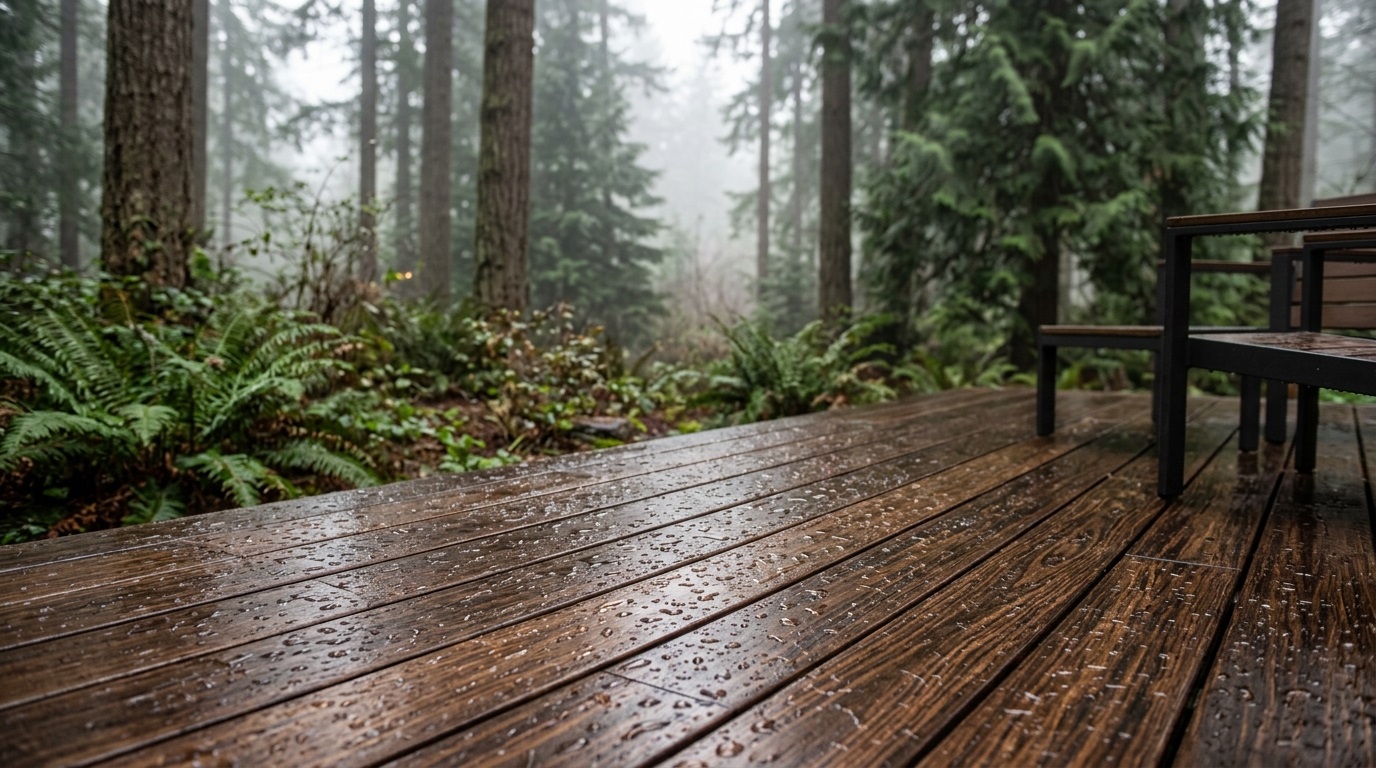
A deck in Seattle, coastal Ireland, or the rainy foothills of North Carolina faces a completely different stress test than a patio in Phoenix. When rain falls for weeks at a stretch and winter sun barely clears the treeline, exterior boards never fully dry out. Moisture lingers in the end grain, pools around fasteners, and sits trapped under fallen leaves. Within five to eight years, ordinary pressure-treated pine starts going spongy around screw holes, cedar turns slick with green algae, and poorly formulated composites sprout black mold spots that refuse to scrub clean.
Thermo-treated strand bamboo decking survives wet climates because high-heat modification strips out the sugars that decay fungi eat, while extreme compression closes the internal pathways water uses to penetrate the board. Properly engineered exterior strand bamboo earns European standard EN 350 Durability Class 1 and Use Class 4 ratings, placing its rot resistance alongside dense tropical hardwoods like ipe and teak. Still, even the densest decking fails if installed over a damp, airless subframe or left buried under wet debris. Knowing where the material’s natural defenses end and smart building practice begins is what keeps a wet-climate deck standing for twenty-five years or more.
Why Wet Climates Destroy Ordinary Wood Decks
Before looking at how strand bamboo holds up, it helps to separate two problems homeowners often lump together: structural rot and surface mold. They look similar at a glance, yet they behave very differently.
Structural rot is caused by brown-rot and white-rot fungi digesting the cellulose and lignin inside a board. Those organisms require three things to colonize wood: sustained internal moisture above roughly 20 percent, oxygen, and an accessible food source in the form of natural plant starches and hemicellulose. In dry climates, rainwater evaporates quickly enough that boards rarely stay above that moisture threshold for long. In maritime and high-rainfall regions, shaded planks stay damp for months at a time, turning softwood decks into an all-you-can-eat buffet for decay fungi.
Surface mold and mildew are far less destructive to the board itself, though they ruin appearances and create serious slip hazards. Mold spores float everywhere outdoors. They do not need to eat the decking material at all—they happily grow on top of airborne pollen, tree sap, barbecue grease, and fine soil trapped on a damp plank. That is why even plastic-capped composite decks grow dark mildew patches in shady backyards.
Early bamboo decking products gave bamboo a rough reputation in wet regions because they were built like indoor flooring: flat-laminated strips glued together with raw starches still intact. Exposed to rain, those boards absorbed water through their hollow vascular channels, swelled, delaminated, and rotted quickly. Modern exterior strand bamboo is an entirely different engineered material.
How Strand Bamboo Decking Stops Rot from the Inside Out
Exterior-grade strand woven bamboo starts with mature Moso bamboo harvested at five to six years of age, when the culm walls have fully lignified. Rather than cutting flat strips, manufacturers strip off the outer green skin and inner pith, then crush the stalk into rough, interconnected fiber bundles. Two manufacturing stages then change the chemistry and physics of the plant permanently.
Thermal Modification Removes Nutrients
Raw bamboo contains naturally occurring sugars and starches that attract fungi and insects. To eliminate that food supply, shredded bamboo strands undergo deep thermal modification—often called high-temperature carbonization—inside controlled heat chambers at temperatures between 180 and 220 degrees Celsius.
At those temperatures, soluble starches and unstable hemicellulose chains break down and caramelize into inert compounds. Decay fungi landing on the board simply have nothing left to digest. That same thermal reaction permanently reduces the number of water-binding hydroxyl groups inside the cell walls. While untreated outdoor timber swings between 12 and 19 percent moisture content across wet and dry seasons, thermally modified bamboo stabilizes at a much lower equilibrium moisture content, typically around 4 to 7 percent under normal atmospheric conditions. Less water inside the fibers means less seasonal swelling, less cupping, and far fewer deep surface checks where rainwater can collect.
High-Pressure Compression Seals Voids
After thermal treatment and conditioning, the dark brown bamboo fibers are coated with exterior-grade phenol-formaldehyde resin and compressed under massive hydraulic tonnage and heat. Raw Moso bamboo has a specific gravity around 0.62 to 0.70, leaving plenty of open microscopic space for water movement. Hot-pressing collapses those hollow vascular cavities completely, pushing finished board density to between 1,150 and 1,250 kilograms per cubic meter.
At that density, the board is heavier than water and harder than almost any commercial hardwood, testing above 9.5 kilograms per square millimeter on the Brinell hardness scale. Water absorption slows to a crawl. In standardized 24-hour water immersion tests, quality exterior strand bamboo shows width expansion under 1 percent and length expansion around 0.1 percent. Because moisture cannot rush into the core, freeze-thaw cycles in cold wet winters do not pry the fibers apart the way they split porous softwoods.
Verified Durability and Mold Ratings
Marketing brochures throw around words like weatherproof loosely, so architects look at independent laboratory protocols instead. Certified exterior thermo-treated strand bamboo consistently achieves Durability Class 1 under EN 350 and CEN/TS 15083 testing—the highest biological durability grade available, matching heartwood teak and ipe. It also qualifies for EN 335 Use Class 4, which covers wood materials exposed to constant freshwater wetting or direct ground contact.
For surface fungus and blue stain resistance under EN 152 and DIN EN ISO 846, properly thermo-treated strand bamboo tests at Class 0, indicating no fungal growth supported by the substrate itself. When shopping for a wet climate, ask your supplier directly for EN 350 Class 1 and EN 152 Class 0 test documentation. If a seller cannot produce those reports, you may be looking at lightly carbonized indoor stock that will fail outdoors.
Surface Mold vs. Structural Rot on Wet Bamboo Decks
Even with a Class 0 substrate rating, homeowners in rainforest climates or heavily wooded lots will occasionally spot faint black specks or a greenish film on their bamboo deck after a long wet winter. Seeing that for the first time can cause unnecessary panic.
In nearly every case, that discoloration is surface biofilm feeding on organic dirt sitting on top of the plank, not rot eating into the bamboo. Oak pollen, pine needles, bird droppings, and damp leaf tannins form a thin nutrient layer on any horizontal outdoor surface. Shaded corners near gutters, under patio furniture, or beneath overhanging branches dry last and show mildew first.
The practical difference is what happens when you clean it. On a rotting softwood deck, scrubbing away green slime reveals soft, fibrous, pitted wood underneath. On thermo-treated strand bamboo, washing away the surface film reveals rock-solid, dense dark bamboo right below. Keeping the deck free of standing organic debris solves ninety percent of wet-climate mold complaints before they start.
Installation Details That Make or Break Wet-Climate Performance
A Class 1 board can still fail prematurely if water is trapped against its underside with nowhere to go. Most wet-climate decking callbacks trace back to subframe design rather than material defects.
Subframe Ventilation and Slope
Airflow underneath a deck matters just as much as the boards on top. Whenever moisture evaporates off damp soil and condenses on the bottom face of the planks, the bottom swells slightly more than the sun-warmed top, causing boards to cup.
Build every wet-climate deck with a gentle drainage slope of 1 to 2 percent away from the house so rainwater sheds cleanly instead of pooling in low spots. Leave open ventilation around the perimeter skirting and maintain generous ground clearance—ideally at least 300 millimeters above bare soil—over a bed of crushed gravel and landscape fabric. Low-profile ground-level decks built directly over damp earth without cross-ventilation are the hardest environment for any wood or bamboo product.
Spacing, Drainage, and End-Grain Sealing
Water drains through the gaps between planks, so tight spacing is a mistake in rainy regions. Maintain a consistent 5- to 7-millimeter gap along the sides of each board so water drops straight through and small leaves do not bridge the seam into a soggy dam. Use marine-grade 316 stainless steel hidden fasteners in coastal zones—standard coated screws corrode quickly in salty, damp air and leave black iron stains on dark bamboo.
Protect the joists themselves with butyl flashing tape across the top edges so water cannot sit between the fastener clips and the wooden framing. Most importantly, seal every single field-cut end with a dedicated exterior end-grain wax sealer immediately after sawing. End grain absorbs moisture several times faster than the flat face of a board, and leaving crosscuts bare invites end checking during the first wet winter.
Practical Maintenance in Rainy Regions
Strand bamboo does not demand constant weekend labor, though a light seasonal routine keeps wet-climate decks looking crisp and safe underfoot.
Sweep the surface regularly during autumn leaf drop and spring pollen season so wet plant matter does not compost inside the board grooves. Twice a year—typically once in late spring and once in early autumn—wash the deck using warm water, a mild pH-neutral soap or oxygen-based deck cleaner, and a stiff nylon brush scrubbing along the grain. Skip chlorine bleach, which strips color unevenly and degrades surface fibers, and keep high-pressure washers on a wide, low-pressure fan setting held well back from the surface so you do not raise splinters or gouge the resin matrix.
Once the boards are clean and thoroughly dry, applying a thin coat of penetrating, UV-protective decking oil once a year enriches the dark espresso color and helps rainwater bead off the surface instead of soaking into microscopic pores. If you prefer a weathered silver-gray patina, you can skip the oil altogether; the bamboo remains structurally sound without it, though periodic washing is still needed to keep mildew from gripping the bare grain.
Frequently Asked Questions
Can Strand Bamboo Sit in Standing Water?
Thermo-treated strand bamboo rated EN 335 Use Class 4 handles frequent rain, pool splash, and marine docks well, though no wood-based decking should be installed where water pools permanently without drainage. Proper slope and under-deck airflow keep boards flat and stable over decades.
Does Wet Bamboo Decking Get Slippery?
Clean exterior strand bamboo typically earns R10 to R11 wet slip-resistance ratings depending on the surface profile. Smooth flat planks are easier to sweep free of moss and pollen, while fine-grooved or brushed profiles add extra grip on rainy stairs and shaded walkways—provided the grooves are kept clean of algae.
How Long Does It Last in Rainy Climates?
When installed over a ventilated, well-drained subframe with stainless steel fasteners and sealed cut ends, certified EN 350 Class 1 strand bamboo decking routinely delivers 25 years or more of structural service life, even in high-rainfall coastal regions.
Building a lasting deck in a wet climate comes down to pairing the right material chemistry with disciplined water management. Thermo-treated strand bamboo brings the density, low moisture uptake, and Class 1 decay resistance needed to outlast relentless rain without relying on heavy chemical preservatives. Give it steady airflow underneath, clean drainage gaps, and a quick seasonal scrub, and your deck will stay solid, flat, and ready to use long after the rain clears.